

Updated October 6, 2026. We’ll update this page within days of any announcement.
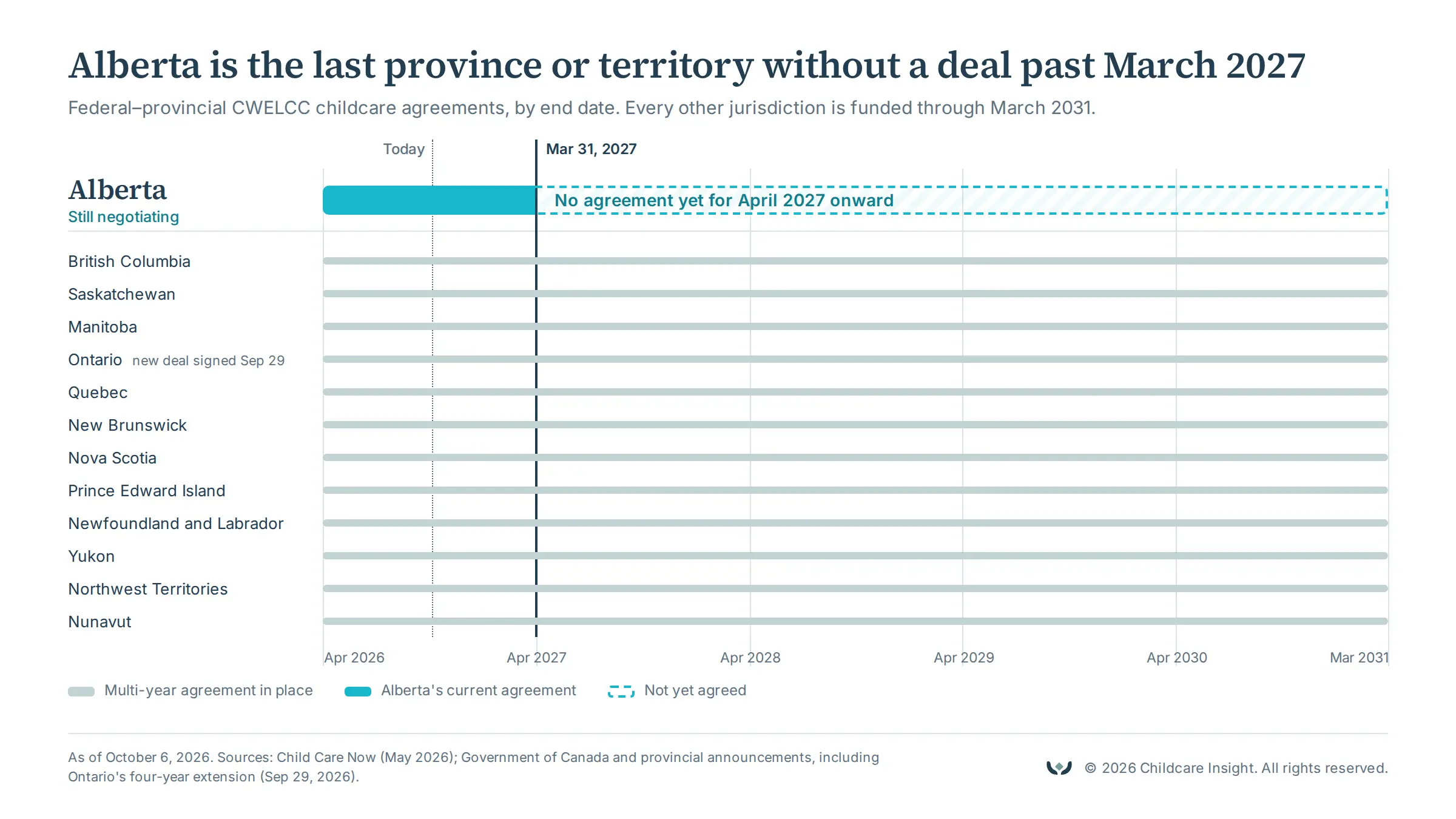
If you run a licensed daycare in Alberta, much of your budget for next April depends on something that hasn’t been decided yet. The federal–provincial agreements that pay for the $15-a-day parent fee end on March 31, 2027. As of this week, Alberta is the only province without a deal that goes past that date.
That doesn’t mean funding stops in April. It means nobody can tell you yet what it will look like. This article covers where things stand, three ways it could go, and what to do in the next six months whichever one happens.
Where things stand
On December 12, 2025, Ottawa and Alberta extended both of their childcare agreements, the Canada-wide (CWELCC) agreement and the older bilateral one, by one year. Both now run to March 31, 2027. The extension came with more than $1.17 billion in federal funding for 2026–27.
The extension also made two changes that matter to operators. It removed the cap on family day home spaces and allowed up to 5,000 more for-profit spaces. Alberta had already hit its original cap of 26,200 for-profit spaces in fall 2025, and it has now allocated those 5,000 additional spaces.
For families, the price hasn’t changed. Since April 1, 2025, parents of children up to kindergarten age have paid a flat $15 a day in Alberta. That works out to $326.25 a month for full-time care and $230 a month for part-time. (The numbers vary across provinces. For example, Quebec has the lowest free in the country at $9.65 a day.)
The rest of the country moved faster. Eight provinces signed new five-year deals. Alberta and Ontario chose one-year extensions instead. Then, in June 2026, Ottawa added up to $5.4 billion over two years to keep fees stable across the country. Alberta’s minister, Demetrios Nicolaides, said he was encouraged by the funding but was still waiting for details. He added that Alberta would keep working toward a long-term agreement.
On September 29, 2026, Ontario signed a four-year extension. It runs to March 31, 2031 and brings nearly $12 billion in federal funding. Ontario had been one of only two provinces, along with Alberta, without a longer-term deal. That leaves Alberta as the last one.
Alberta’s priorities for a new deal are on the record. In August 2025, the province said it had written to Ottawa asking for three things:
- an income-tested system, where what a family pays depends on its income;
- more provincial flexibility in how the system is run;
- fair access to public funding for both non-profit and for-profit providers.
We haven’t seen a public update on how Alberta’s talks are going since the June funding announcement.
Why this matters for your budget
In childcare, federal funding is the larger share of the pot. In 2025, Alberta said it would put in about $720 million that year, alongside roughly $1.2 billion from Ottawa.
The timing also lines up badly for operators. Eligible providers sign an Affordability Grant agreement with the province every year. Your next one will cover a year that the current federal deal doesn’t reach.
Three ways this could go
We’re not predicting an outcome. Each of these has happened somewhere in Canada in the last eighteen months, so each one is worth planning for.
- A multi-year deal before March 31. This is what Ontario and eight other provinces now have. It would give you a stable funding base for several years. The terms could still change, though. Ontario’s deal only holds its fees at current levels until June 30, 2027. Alberta has also said it wants income testing. If that ended up in a new deal, parent fees could vary by family income again, which would mean new billing work and more paperwork.
- Another short bridge. The same rules carry on for one more year. This means the least disruption on April 1, but the same uncertainty again next fall. You’d keep planning only about twelve months ahead.
- A late deal or a gap. The new terms might arrive close to April 1, or after it. Alberta has changed funding on short notice before: the April 2025 changes took effect two months after they were announced in January. If that happens again, fees or grant amounts could change with little warning.
| If this happens | What could change in April | Your main risk |
| Multi-year deal | Fee model, eligibility rules, reporting | Admin changes, especially if income testing returns |
| Short bridge | Probably very little | Another year of short-range planning |
| Late deal or gap | Fees and grant amounts, with little notice | Cash flow, parent communication, staff anxiety |
What to do in the next six months
Regardless of the outcome, here are things you can do for some more peace of mind.
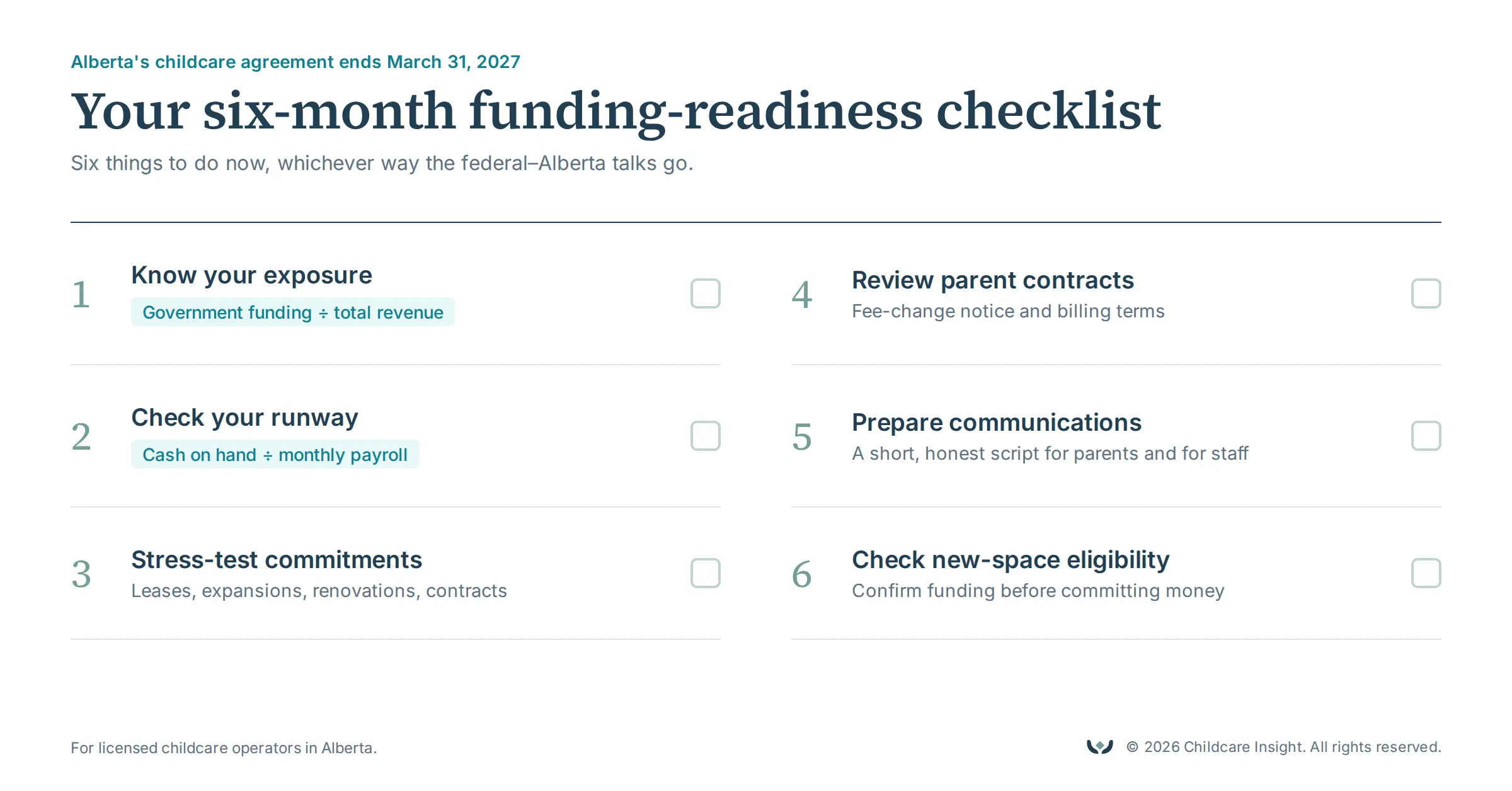
1. Work out how much of your revenue depends on the agreement.
The first step toward doing anything is knowing the status quo. So,
- Take your last three months of revenue.
- Add up everything that came from government: the affordability grant, wage top-ups, and any other provincial grants.
- Divide that by your total revenue.
Here’s an example with made-up numbers:
A center with 60 full-time children collects 60 × $326.25, which is $19,575 a month in parent fees. If its total monthly revenue is $55,000, then about 64% comes from government funding.
That 64% is the share of the business riding on a decision that hasn’t been made yet.
2. Check how long you could cover payroll.
Divide your cash on hand by one month’s payroll. Suppose a grant payment arrived late or smaller in April: how many months could you keep paying staff? If the answer is less than one month, building a buffer or arranging a line of credit before spring should move to the top of your list.
3. Stress-test big commitments.
This isn’t a reason to stop growing. But a new lease, an expansion, a renovation, or a multi-year vendor contract signed now should still work if your funding changed in April. If it wouldn’t, make sure the contract gives you a way out.
Some non-profits are already living this: since June 4, 2026, new non-profit programs only qualify for affordability funding if they were in the final stages of licensing by that date or had an approved provincial capital grant. This has left some centers still under construction choosing between opening unfunded and pulling out and absorbing the penalties.
4. Review your parent contracts.
Check how much notice you have to give families before changing fees or terms. If something changes on April 1, you’ll need time to update billing and tell every family.
If you’re unsure what your contract allows, ask a lawyer. If you need help finding one with childcare experience, get in touch with us and we’ll connect you with one.
5. Give your director scripts.
Parents will ask, and the people at the front desk need a short, honest answer. Something like this works: “Your fee is set at $15 a day until March 31, 2027 under the current agreement. Nothing has been announced for after that yet. We’ll tell you as soon as the province confirms anything.”
Staff will ask about wage top-ups. Alberta has not changed their wording in light of the upcoming expiration, saying they’re continuing top-ups under its federal funding agreements. So again, you can tell staff that their top-ups are set until March 31, 2027 and that you’ll tell them as soon as credible sources say otherwise.
6. If you’re planning new spaces, confirm your eligibility first.
Alberta’s target is 68,700 new spaces by March 2027. As of April 2026, it had reached 57,699, which is 84% of the target. Funding for new spaces is now limited and only goes to eligible programs. Check the province’s start a childcare program page before you commit funds.
Dates to keep an eye on
- Any day between now and March 2027: a federal–Alberta announcement could land at any time. Ontario’s came with six months to spare.
- Your 2027–28 Affordability Grant agreement: the first document that will show what the next year actually looks like.
- Alberta’s spring budget: worth reading closely for its childcare line.
- March 31, 2027: the current agreements end.
We track federal and Alberta childcare policy closely and will update this page as things move. If you want help understanding how a funding change could affect your center’s revenue and cash flow, book a free call and we’ll work through it with you.